
Inspection and moisture mapping
We look for the moisture source first, then use moisture meters and visual inspection to identify where mold growth is active versus where staining is old or unrelated.
Serving Cypress, Texas & surrounding areas
24/7 Emergency Response
If you are seeing spots, smelling musty odors, or dealing with a recent leak, our certified team can inspect, contain, remove, and restore the affected areas with a clear scope and straightforward pricing.
Searching for mold remediation Cypress TX usually means one thing: you want the problem stopped at the source and removed the right way, without spreading spores through the rest of the home or business.
In Cypress, moisture issues often follow roof leaks, plumbing failures, HVAC drain line clogs, or humidity that lingers in closed-up rooms. When mold is disturbed without proper containment, it can move into adjacent rooms through normal airflow, return grilles, and gaps around doors. That is why professional remediation is built around controlled work zones, filtration, and verification steps.
Water Damage Restoration Cypress TX focuses this service on safe removal and practical restoration. You get a written scope, what areas are affected, what will be removed or cleaned, what needs drying, and what the rebuild steps look like so you can make decisions before work starts. If you are comparing companies, Water Damage Restoration can walk you through what a proper remediation plan includes and what questions to ask during an inspection.
We look for the moisture source first, then use moisture meters and visual inspection to identify where mold growth is active versus where staining is old or unrelated.
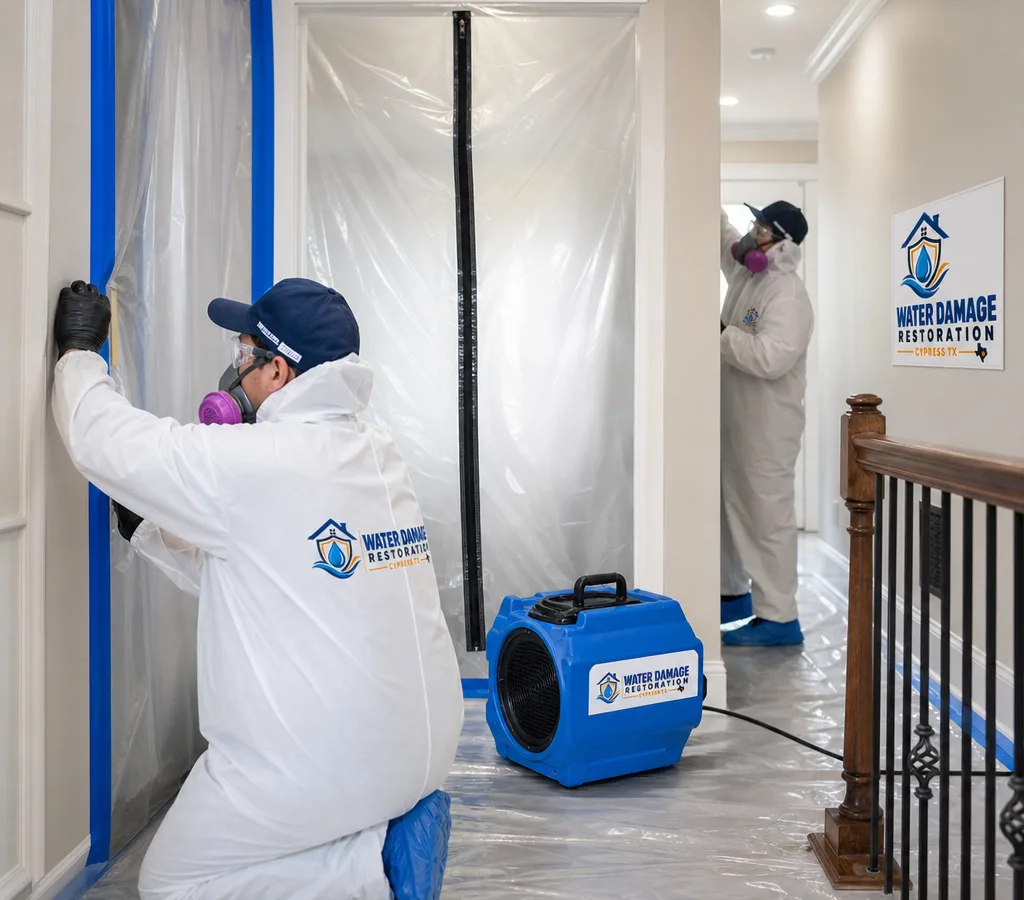
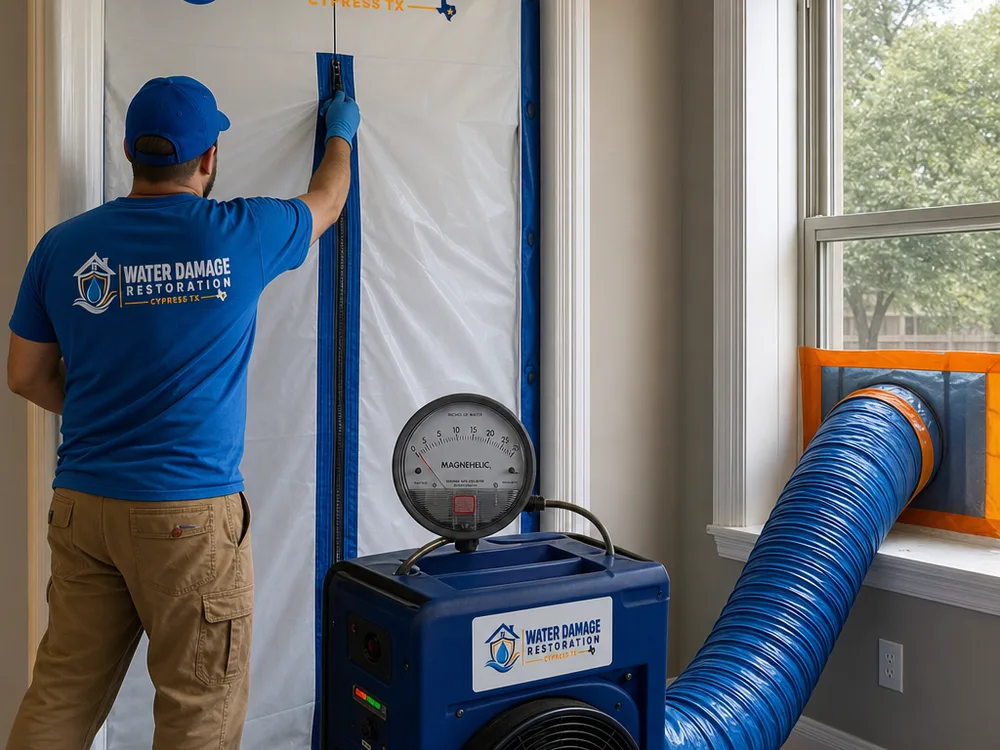
We isolate the work area with plastic barriers and run HEPA-filtered negative air machines to keep spores from migrating into clean areas.
Air scrubbers and HEPA vacuums capture fine particulate. Hard surfaces are cleaned with appropriate antimicrobial methods based on the material and condition.
Porous materials that cannot be reliably cleaned, such as contaminated drywall or insulation, are removed and disposed of according to the scope.
Remediation fails if the area stays damp. We address drying targets and ventilation so the conditions that fed growth are corrected.
You receive notes on the affected areas, the containment approach, and what was removed or treated so you have a record for property management or insurance conversations.
The biggest difference between a real remediation and a surface wipe-down is containment. We build a controlled work zone so spores and debris stay inside the affected area.
Typical controls include:
This matters in common Cypress home layouts where bedrooms open off a central hall and the HVAC return can quickly move air through the whole structure. If you have visible growth around a vent, near a bathroom, or behind a baseboard after a leak, we treat the area as potentially connected until inspection confirms the boundary.
For businesses, we plan around foot traffic and operating hours so cleanup can happen without spreading dust to customer areas, offices, or inventory.
We identify the affected materials, likely moisture source, and whether the problem is localized or has spread into adjacent cavities (behind drywall, under flooring, or in insulation).
We protect clean areas, establish negative air, and stage HEPA filtration so demolition and cleaning stay controlled.
If drywall, insulation, carpet pad, or other porous materials are impacted, removal is usually required for a reliable result.
We HEPA vacuum, wipe, and treat framing and hard surfaces as appropriate, then address odor sources when needed.
We monitor moisture content and humidity. If the moisture source is not corrected, remediation does not hold, so we verify drying and conditions.
Once the area is clean and dry, we review next steps for repairs, such as replacing drywall and trim, and what should happen before painting or reinstalling flooring.
Mold remediation in Cypress typically ranges from about $900 to $6,000+, depending on how many rooms are affected and whether materials like drywall, insulation, cabinets, or flooring need removal. A small, contained area (for example a closet or a section of drywall) often lands in the lower end, while multi-room or behind-the-wall remediation with rebuild planning trends higher.
Final pricing depends on the size of the containment zone, access (tight attics or crawlspaces), how much demolition is required, drying time, and whether odor treatment or detailed cleaning is needed. The exact cost is confirmed after an on-site inspection and a written scope.
If you suspect mold, the fastest way to limit damage is to get an inspection and a written plan before anyone starts tearing out materials or spraying chemicals.
Call for Emergency Help“After a slow leak in a wall, we found mold when the baseboards started to swell. The crew contained the area, kept the house clean during demo, and explained what had to be removed versus what could be treated.”
“We needed remediation in a small office suite and could not shut down for long. They scheduled around our hours, used negative air, and left us with clear documentation of what was done.”
Scheduling depends on current demand, but urgent situations are typically prioritized because active moisture and disturbed growth can spread quickly. After you reach out, we confirm the location in Cypress (ZIP 77410 and nearby) and set an inspection time so we can define the containment area and next steps.
Not always; if there is visible growth and a clear moisture source, remediation can often proceed based on inspection and a written scope. Testing can be useful when you cannot see the affected area, when occupants have health concerns, or when a third party report is needed for a property manager or claim file.
Sometimes, but only when the affected material is non-porous or the growth is truly on the surface. Drywall and insulation are porous, so when they are contaminated, removal is commonly required to avoid leaving growth behind inside the paper facing or cavities.
Mold returns when moisture is still present or returns later, such as an unrepaired leak, high indoor humidity, or condensation around HVAC supply and return areas. A successful remediation includes drying targets and a plan to correct the moisture source so conditions no longer support growth.
It depends on where the work area is, how large it is, and whether occupants have sensitivities. With proper containment and negative air, many projects can be completed while residents remain in unaffected parts of the home, but we will advise if temporary relocation from nearby rooms is the safer option.
Coverage varies by policy and what caused the moisture event. Sudden, accidental damage (like a burst pipe) is more likely to be covered than long-term seepage. We provide documentation and a clear scope that you can share with your carrier so coverage decisions are based on the facts of the loss.
A small, contained project can often be completed in 1 to 2 days, while larger multi-room or behind-the-wall remediation can take several days, especially if drying is required. The timeline is driven by containment setup, how much material must be removed, and how quickly the structure reaches safe moisture levels.
Tell us what you are seeing and where it is showing up. We will schedule an inspection in Cypress, explain the containment and removal plan, and provide straightforward pricing before work begins.